

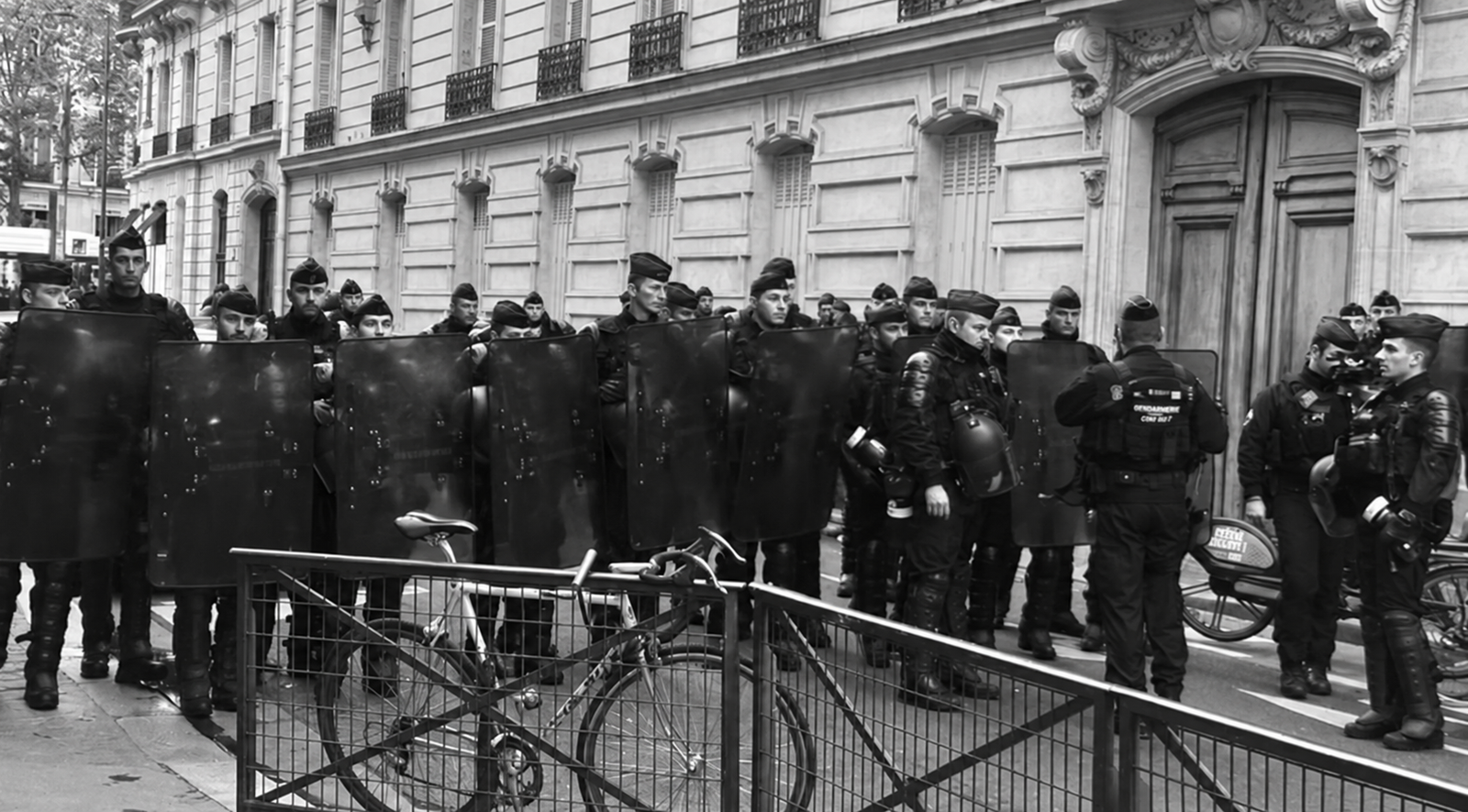
European news headlines over the last few weeks have been dominated by coverage of the civil unrest in France and later across Europe. Characterised by blockades, arson and vandalism, the French have been protesting for a multitude of different causes, but the igniting spark that started it all was the French high school movement, appealing to the government to better fund the ‘lycées’, the French equivalent of college/sixth form. The ‘lycéens’, French students who attend these schools, first began to protest in the Parisian suburbs before the movement spread across the nation. Their method of protest included marches, but also blockading their schools early in the morning to prevent opening. While the latter is illegal, lycéens maintained these blockades in the face of police intervention. Faced with fierce resistance and a refusal to yield, French public order police, most notably a unit known as the Compagnie Républicanes de Sécuritié (or CRS for short), have resorted to a range of ‘crowd suppression techniques’.
The CRS and other French security forces use an infamous technique called ‘la nasse’, or ‘kettle’ in English. When officers are concerned about ‘serious, imminent violence’, they can barricade off all exit points to a street, and keep anyone, protestors or otherwise, trapped inside. Once encircled, citizens can be subjected to searches, tear gas, arrests, or just simply held for hours (13 in one instance). Importantly, this tactic violates rights of its detainees by holding them without scrutiny, making no distinction between protestor or bystander. Kettling can also prevent the effective ingress of medical personnel, delaying first aid to those injured in the protests. Even when not employing kettles, French police officers have been recorded multiple times using heavy-handed tactics such as shield charges, tear gas, or ‘snatch squads’, where a group of officers will advance into
the crowd and past their shield line to apprehend a ‘suspect’, before dragging them back behind their line. Armoured vehicles with mounted high pressure water cannons have also been used in an attempt to disperse crowds. When used in inclement weather, protestors who have their clothes soaked through by water can very quickly become hypothermia patients. The problem with these techniques is primarily the way in which they are employed. French police seem to be largely indiscriminate in their application of crowd control techniques, leading to a disproportionate level of violence against protesters who may not be guilty of anything but holding a sign. They also frequently fail to give prior warning, which would allow those not interested in a violent confrontation time to move away. Personally, a warning like this would have saved me from inhaling a healthy whiff of tear gas as a canister was randomly shot into a crowd as I walked nearby, not involved in the protests whatsoever.
The argument against state violence by the French police should, however, not be made without qualification. There are, as with most protests, elements of rioters who are interested only in looting, arson attacks and other criminal actions in the hopes that the surrounding chaos will shield them from consequence. These people should, of course, feel the full force of the law. In this way, the job of public order officers is unenviable; there exists a very fine line between legitimate protestors and offenders. Distinguishing between them is extremely difficult, especially with widespread anonymity efforts including face masks and dark clothing. French officers run into criticism because they get the balance between facilitating the right of protest and preventing violence wrong. Protestors are presumed guilty of rioting, sometimes preemptively, and are too hastily subjected to a range of control measures that are disproportionate to the actions they have taken.
As of writing, this latest bout of protests have ensued across France for a month. The French are no strangers to civil unrest, and have garnered an international reputation for taking to the streets over political problems. Even in the face of repressive, indiscriminate police violence, the people of France continue to turn out in their hundreds of thousands when impassioned by a cause. As a nation born of protest and revolt, the importance of protest and demonstration is paramount to French identity. It is my belief that the tactics utilised by French police bolsters this identity by perpetuating an ‘us versus them’ mentality and portraying the state’s actors (the police), and therefore the state itself, as an oppressive, violent and hostile entity to be rioted against. Far from being deterred, the French seem incensed by videos of their fellow demonstrators being beaten by batons, trampled by shield charges or detained in kettles for hours. There is some suggestion that, with an election looming, top brass in the French government are keen to appease the right by
taking a ‘tough’ stance on the protests, hence the increased employment of severe measures on protestors. These officials seem not to understand that, as well as clearly failing to suppress the protests, heavy handed policing is also backfiring massively by encouraging leftists disgusted with the government’s handling of the protests to take their votes elsewhere. With protests seemingly not slowing down and tensions ever-rising as the government refuses to capitulate to the demands of the protestors, the next few weeks in France and across Europe are set to be very interesting indeed.